
Summary:
- Charging a standard Nickel Manganese Cobalt (NMC) or Nickel Cobalt Aluminium (NCA) EV battery to 100% every night accelerates chemical degradation and reduces long-term battery health.
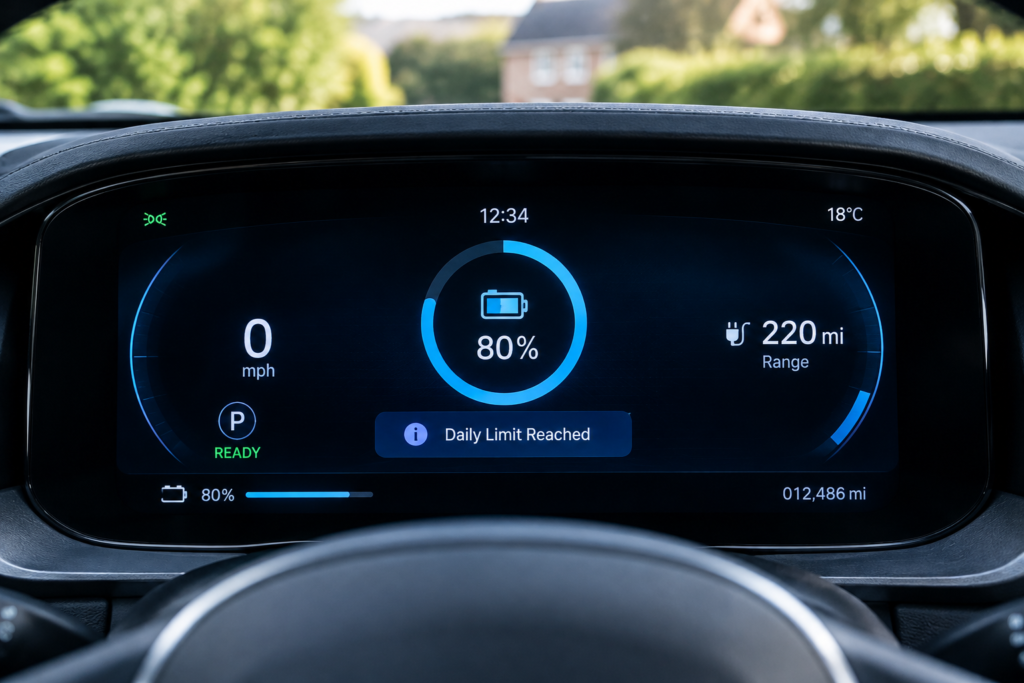
- For routine daily driving, most major manufacturers recommend capping your daily charge limit to 80% to minimise high-voltage chemical stress and preserve regenerative braking efficiency.
- Lithium Iron Phosphate (LFP) batteries—commonly found in standard-range models from BYD, MG, and Tesla—are an exception and benefit from regular 100% charges to calibrate the Battery Management System (BMS).
- Setting an 80% daily charge limit integrates seamlessly with off-peak overnight smart tariffs, protecting your battery pack while keeping running costs as low as 2p per mile.
Hi, I’m Josevi. When drivers transition from petrol cars to their first electric vehicle, their daily routine usually mirrors their smartphone habits: they park on the driveway, plug in the cable before bed, and expect to wake up to a 100% battery every single morning. But should you charge your EV to 100% every night? The short answer for the vast majority of EV owners is a definitive no. Unless your car uses a specific battery chemistry, topping up to 100% on a daily basis causes unnecessary electro-chemical stress that permanently reduces your total driving range over time.
In this guide, we will explore the underlying science of lithium-ion degradation, examine the vital differences between NMC and LFP battery chemistries, and outline four simple daily practices to ensure your vehicle’s power pack remains healthy for hundreds of thousands of miles.
The Science of Lithium-Ion Battery Degradation
To understand why daily full charges cause harm, we need to look at what happens inside a traction battery pack during a charging cycle. Most modern electric vehicles rely on lithium-ion cells containing a cathode (positive electrode), an anode (negative electrode), and a liquid electrolyte.
When you plug your car into a home wallbox, lithium ions are forced out of the cathode and pushed into the graphite anode. When the battery reaches high states of charge (above 80%), the physical structure of the anode becomes saturated with ions. This high-voltage state increases mechanical pressure within the cell and causes the electrolyte to decompose faster, forming a parasitic film known as the Solid Electrolyte Interphase (SEI) layer.
According to extensive fleet data published by Geotab, the average EV battery degrades at a rate of roughly 2.3% per year. However, vehicles that are routinely kept at high states of charge (above 80% SoC) in warm ambient conditions experience significantly faster capacity loss than vehicles managed within a middle-state charge band.
Why You Shouldn’t Charge Your EV to 100% Every Night
If you drive a vehicle equipped with a standard NMC or NCA battery (found in long-range models from Volkswagen, Hyundai, Kia, BMW, and Tesla), adhering to the EV battery health 80 percent rule is the most effective action you can take to safeguard your asset.
Here are the primary technical reasons to avoid a 100% daily charge:
1. High Voltage and Thermal Stress
A battery cell sitting at 100% state of charge operates at its maximum chemical potential voltage (typically 4.2V per cell). Sustaining this high voltage overnight generates internal resistance and localized heat. Heat and high voltage combined are the two greatest catalysts for permanent capacity loss.
2. Loss of Regenerative Braking
When your vehicle’s battery is filled to 100% capacity, there is physically no room left to store recaptured kinetic energy. Consequently, your car’s regenerative braking system will be automatically disabled or heavily restricted until the battery drops below 90%. This forces you to rely entirely on mechanical friction brakes, increasing wear on your brake pads and discs.
3. Slower Charging Rates
The final 20% of a battery charge takes considerably longer due to the battery management system reducing current to prevent thermal runaway. Trying to squeeze in that last 20% every night wastes energy and extends charging cycles unnecessarily.
LFP vs NMC: The Battery Chemistry Exception

The rule about avoiding a 100% charge applies primarily to ternary batteries (NMC/NCA). However, the market has seen a rapid rise in LFP vs NMC battery EV charging dynamics due to the adoption of Lithium Iron Phosphate (LFP / LiFePO4) technology.
LFP batteries are increasingly installed in standard-range electric vehicles, including the Tesla Model 3 RWD, BYD Atto 3, MG4 EV, and various GWM Ora models.
Why LFP Batteries Can Be Charged to 100%
- Chemical Stability: LFP cathodes feature a robust iron-phosphate crystalline structure that does not degrade under high voltage as quickly as nickel-cobalt formulations.
- BMS Voltage Calibration: LFP cells have an extremely flat voltage discharge curve. This means the car’s computer struggles to calculate the remaining battery percentage based on voltage alone. Charging an LFP battery to 100% at least once a week resets the calibration of the Battery Management System (BMS), ensuring your dashboard range display remains accurate.
If you are unsure which chemistry your car uses, check your owner’s manual or look at your vehicle’s charging settings screen. If the manufacturer recommends setting a EV daily charge limit slider to 80% or “Daily Use”, you have an NMC/NCA battery. If there is no recommended daily limit, or if the manual explicitly tells you to charge to 100% regularly, you have an LFP pack.
4 Practical Rules to Maximise Your EV Battery Lifespan
Protecting your battery pack does not mean you have to live with range anxiety. By making minor adjustments to your daily routine, you can preserve health while keeping your car ready for every journey.
1. Set Your Charge Limit to 80% for Daily Commutes
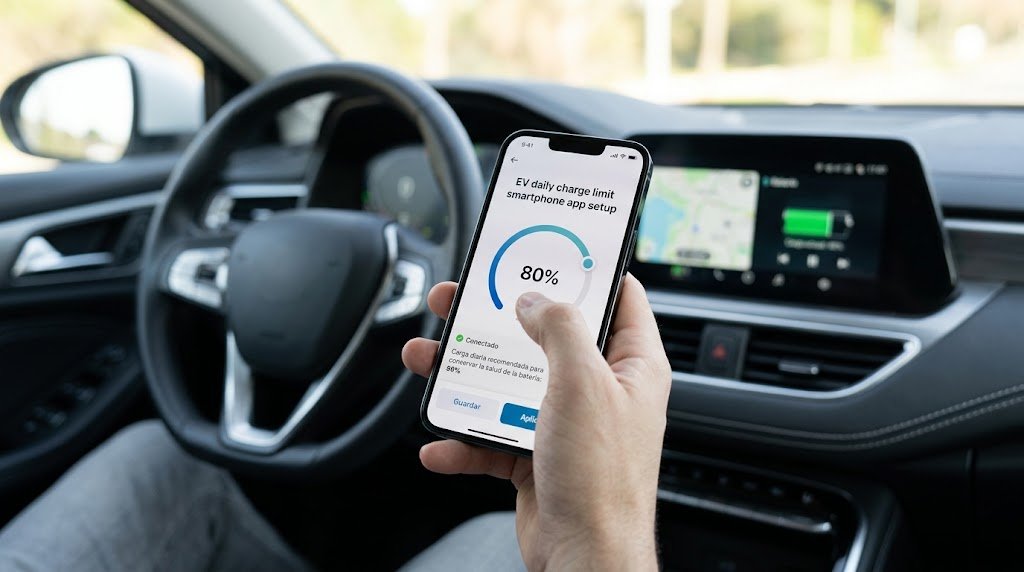
For 90% of your driving—such as school runs, supermarket trips, and daily commutes—an 80% charge provides more than enough range. You can easily set this threshold using your vehicle’s infotainment screen or smartphone app.
2. Charge to 100% Just Before Long Road Trips
When you need full range for a holiday or long business drive, charging to 100% is completely fine. The key is timing: schedule your charger so that the battery reaches 100% right before you depart. This prevents the vehicle from sitting at maximum voltage on your driveway for hours.
3. Take Advantage of Off-Peak Overnight Tariffs
Capping your charge limit to 80% makes overnight charging faster and cleaner. You can set your smart home wallbox to charge during low-cost overnight windows. If you want to understand how off-peak rates work, read our full breakdown of Economy 7 vs Smart EV Tariffs.
4. Maintain Safe Charging Conditions at Home
Whether you park on a private driveway or charge on the road, ensure your physical hardware is safe. If you run cables across a pavement, use the best EV cable protectors for pavement charging to prevent trip hazards. Furthermore, if you plug in via emergency 3-pin setups, review our safety guide on how to charge an electric car from a 3-pin plug without overheating domestic sockets.
Frequently Asked Questions (FAQs)
Is it bad to let my EV battery drop below 20%? Just as sitting at 100% causes high-voltage stress, letting your battery sit near 0% causes deep discharge strain and risks cell imbalance. Ideally, aim to keep your state of charge between 20% and 80% for daily operation.
Does rapid DC charging damage the battery more than home AC charging? Frequent reliance on ultra-rapid DC public chargers (100kW+) generates significant heat, which can accelerate degradation over time compared to gentle 7kW AC home charging. For daily driving, home wallbox charging remains the healthiest option for your pack.
What happens if I accidentally leave my car at 100% while on holiday? Leaving an NMC battery sitting at 100% in hot weather for weeks at a time will cause elevated thermal degradation. If you are leaving your car parked at an airport or at home while away, leave the battery stored at around 50% to 60% charge.
Conclusion
Taking care of your electric car does not require complex routines, but it does require understanding your vehicle’s battery chemistry. For most drivers operating standard ternary packs, asking should you charge your EV to 100% every night leads to a clear conclusion: capping your routine daily limit at 80% protects the internal cell chemistry, preserves full regenerative braking performance, and prevents premature range loss.
Reserve 100% charges for long road trips, or charge to full regularly if your vehicle uses LFP chemistry. By setting a simple 80% limit in your car’s settings, you can enjoy peace of mind knowing your battery will deliver optimal range and performance for years to come.