
Summary:
- For the vast majority of homeowners in England, Wales, and Scotland, installing a home charging point falls under Permitted Development rights, meaning no formal application is required.
- The charger must meet specific size criteria (under 0.2 cubic metres) and height restrictions to remain exempt from local council bureaucracy.
- Exceptions exist: you will need to submit a formal application if you live in a listed building, within a strict conservation area, or if you do not own the freehold to your flat.
- Recent updates in 2025 and 2026 have relaxed driveway boundary rules and paved the way for cross-pavement charging, giving homeowners more flexibility.
Hi, I’m Josevi. As a passionate EV driver and advocate for home energy solutions, the absolute most common question I get asked by anxious new electric vehicle owners is: do I need planning permission for an EV charger? It is completely understandable to be worried. Nobody wants to spend hundreds of pounds installing a shiny new wallbox, only for the local council to send a letter demanding its removal. The good news is that the UK government is actively trying to make the transition to zero-emission driving as frictionless as possible. In almost every standard residential scenario, you can skip the red tape entirely.
However, “almost every scenario” is not the same as every scenario. British planning law is full of historical quirks, protected buildings, and hyper-specific local exceptions. In this exhaustive guide, I am going to break down the exact legal framework for 2026, pulling the facts directly from the current Town and Country Planning Order. Whether you are bolting a unit to a modern semi-detached house or trying to charge outside a 19th-century cottage, here is everything you must know before calling an electrician.
What Are Permitted Development Rights?
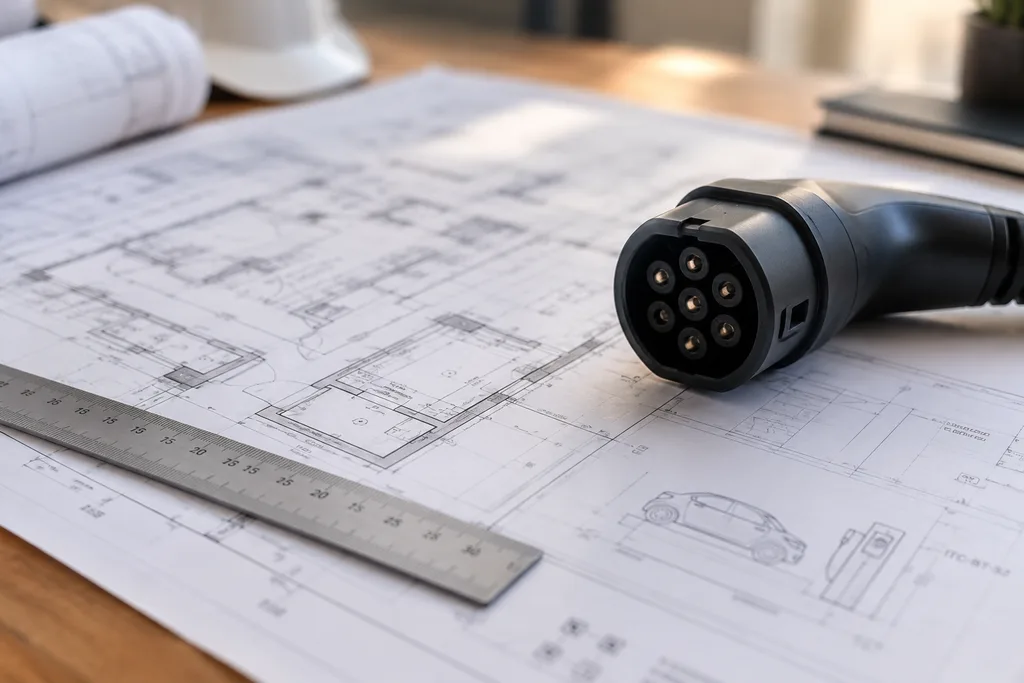
Before we dive into the specifics of your driveway, we need to understand how the system works. In the UK, certain minor property improvements and structural alterations can be undertaken without applying for formal approval from your local planning authority. These are legally known as Permitted Development (PD) rights.
If your proposed installation fits perfectly within the predefined boundaries of these rights, the law grants you automatic permission. You do not need to fill out forms, pay council fees, or wait weeks for a decision. The government deliberately included electric vehicle charging infrastructure within these rights to speed up the nationwide adoption of EVs.
So, Do I Need Planning Permission for an EV Charger?
For most standard homes, the answer is a resounding no, provided your installation adheres to strict physical limitations. To qualify as an EV charger permitted development UK installation, your setup must meet the following criteria.
1. Wall-Mounted Chargers (Size Limits)
If you are attaching the unit directly to the exterior wall of your house or garage (Class D), the primary restriction is the physical volume of the box. The charging outlet and its casing must not exceed 0.2 cubic metres.
To put that in perspective, 0.2 cubic metres is massive—roughly the size of a very large suitcase. Almost every domestic smart charger on the market today is significantly smaller than this limit. As long as your chosen charger is a standard residential model, it easily complies.
2. Standalone Upstand Chargers
If you do not have a suitable wall and prefer to mount your charger on a pole or pedestal in your driveway (Class E), different rules apply. The EV wallbox height limits UK law dictates that the upstand and the mounted outlet must not exceed 1.6 metres in height from the surface of the parking area, provided it is within the curtilage (boundary) of a dwellinghouse or block of flats. Furthermore, you are only permitted to install one upstand per parking space.
3. Safety and Siting Conditions
Your installation must not create an obstruction or a public safety hazard. It must be installed within your property boundary (a lawfully used off-street parking area).
I always tell my readers to think practically. If the cable is going to trip your postman, you have a problem. Even if the box itself does not require permission, your electrical setup must still comply with Building Regulations (Part P). Moreover, it is crucial to use built-in PEN fault protection so you do not have to hammer an ugly earth rod into your beautiful front lawn.
When Permitted Development Rights Do Not Apply
The automatic permissions disappear the moment your property falls into a protected category or a complex ownership structure. If any of the following apply to you, you must pause and submit a formal application to your local council.
Listed Building EV Charger Permission
If you live in a property designated as a Listed Building, you do not have automatic permitted development rights for a charger within the curtilage of that building. The aesthetic preservation of the nation’s heritage strictly overrides your desire to charge a car.
To proceed, you must apply for both standard planning permission and Listed Building Consent. The council will heavily scrutinize the visual impact. You will likely need to choose a very discreet, compact charger and hide the cabling flawlessly to get it approved.
Conservation Area EV Charger Rules

Conservation areas are slightly different. You usually retain some permitted development rights, but they are heavily restricted. If your house is in a conservation area, installing a charger on a prominent street-facing wall (the principal elevation) will almost certainly require consent.
In my experience, if you can mount the charger on the side or the rear of the property where it is completely hidden from the public highway, the council is much more likely to wave it through. However, it is absolutely essential to check with your local authority first, as some councils issue “Article 4 Directions” which strip away all permitted development rights entirely.
Flats, Leaseholds, and Shared Driveways
If you live in a flat, the permitted development rights belong to the freeholder of the building, not to you as an individual leaseholder. You cannot unilaterally drill into the exterior brickwork of an apartment block. You will need written consent from the freeholder or managing agent, and depending on the building’s classification, a formal planning application may still be required.
The New 2025 and 2026 Legal Updates (Cross-Pavement Charging)
The UK regulatory landscape is constantly evolving to accommodate the boom in electric vehicles. In May 2025, the government relaxed the rules regarding how close a driveway charger could be to the public highway, removing the old two-metre setback rule and giving homeowners much more flexibility on where to position their wallboxes.
More recently, in September 2026, the government confirmed intentions to expand permitted development rights to include cross-pavement charging solutions (like dedicated charging channels cut into the public footway).
However, you must separate planning law from highway law. While a cross-pavement channel might soon be exempt from needing planning permission, it will absolutely still require formal consent from the local highway authority under the Highways Act 1980. You cannot legally dig up the pavement yourself. If you must run a cable over the pavement temporarily, always use high-visibility EV cable protectors and consult our guide on charging an EV on the street UK to ensure you avoid liability claims.
Frequently Asked Questions (FAQs)
Can I install an EV charger if I only have on-street parking?
If you do not have a private, lawfully used off-street parking area (like a driveway or garage), you cannot use permitted development rights to install a charger. You will need formal permission from the local highway authority to implement any street-charging solution.
What happens if I install a charger without permission on a listed building?
Carrying out unauthorized work on a listed building is a criminal offence in the UK. The council can force you to remove the charger, restore the brickwork at your own expense, and potentially prosecute you. Always secure your listed building EV charger permission before booking an installer.
Where can I find the official government regulations?
You should always double-check your specific situation by visiting the GOV.UK Planning Portal, which provides the exact statutory wording for the Town and Country Planning Order.
The Bottom Line
Navigating British property law can feel like a headache, but the system is genuinely designed to favour the EV driver. As long as you own your freehold, live in a standard unlisted property outside of a conservation area, and choose a reasonably sized charger, you can proceed without involving the council at all.
However, always err on the side of caution. If your property has any historical significance or complex ownership, sending a quick email to your local planning department will save you immense stress down the line. Ultimately, if you are still asking yourself do I need planning permission for an EV charger, the answer is probably no, but a five-minute check of your property’s deeds is the smartest investment you can make before upgrading your home.